
The multi-millionaire janitor
Lessons learned from a patience-built wealth

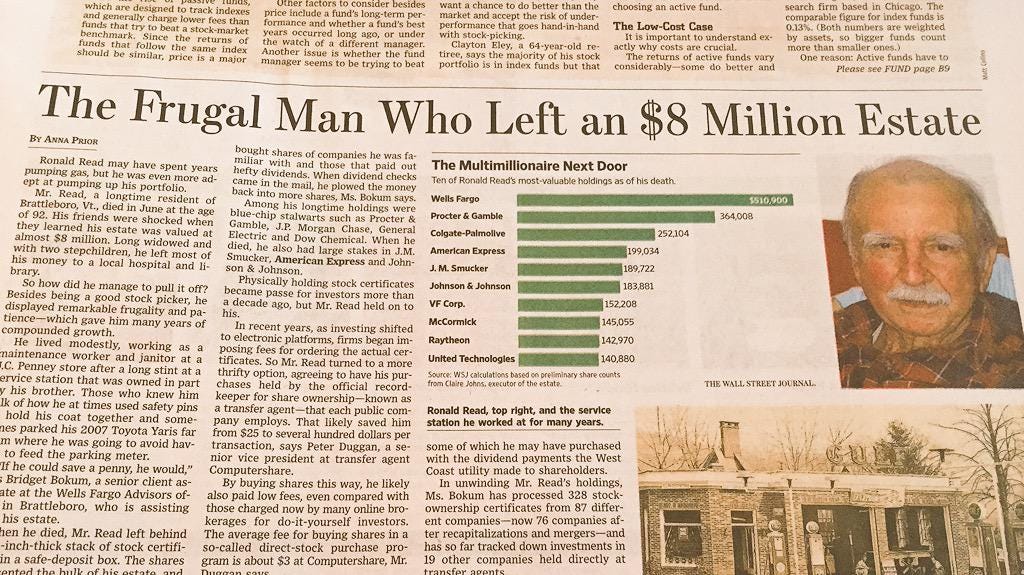
2,813,503 people died in the United States in 2014. Fewer than 4,000 died with a net worth of more than $8 million. Ronald Read was one of them.
Ronald Read turned his salary into more than $8 million in wealth during his life. Without a college background, no connections in the investing industry, and no Bloomberg platform to dig into financials, how did he do it?
Mr. Read was born in 1921 and worked as a janitor and gas station attendant. He bought exclusively stocks of companies he knew well, such as Pacific Gas and Electric Company, CVS Health, and Johnson & Johnson. He avoided companies he didn’t understand, like tech companies, and although he owned shares of Lehman Brothers when the company went bankrupt, he still managed to turn his savings into an $8 million fortune.
Accumulating these shares for his entire life and investing his savings for decades, he accomplished the goal of retiring as a millionaire even with a blue-collar worker wage. His life was an example of frugality and rational investing.
Out of those more than two million people who died in 2014, many of them probably earned more money than Ronald Read. However, his fortune was among the top 0.1% of them.
What can we learn from him?
Stick to your circle of competence
Although the stock universe is huge, you don’t have to know everything about every stock. As Charlie Munger and Warren Buffett say, you can have a pile of companies classified as “too hard to understand.” Not because you’re a dummy, but because they are outside your circle of competence. And there’s nothing wrong with it.
There will always be enough companies that you know well, whose details and ways of making money are familiar to you, and for which you don’t need the most detailed discounted cash flow model in the world to know whether they will be a good investment or not.
Staying within what you know minimizes mistakes. Of course, this doesn’t mean you won’t make mistakes. Ronald Read himself owned shares of Lehman Brothers when the company went bankrupt during the financial crisis. But the rest of his portfolio more than compensated for what he could have lost in that position.
Don’t do stupid things
We often see people selling after feeling fear about the stock market, or jumping into a crazy bubble about to explode. Psychology plays a role, and you have to resist emotional tests in investing. If you avoid doing stupid things in times of extreme emotions, you will do well.
When we talk about Read owning shares of Lehman Brothers, we know (with hindsight, of course) that Read made a mistake. But that didn’t lead him to sell all his stocks because he failed when selecting one company. Mistakes happen, and we have to internalize that they will keep happening. However, we cannot allow those mistakes to cloud our judgment and push us into doing something stupid.
Let your stocks compound and be patient
Patience is one of the most important attributes in investing. And one of the biggest challenges is maintaining a position even if it has been performing poorly for years. Peter Lynch used to say that it took stocks several years to deliver strong performance. And we have to sit tight waiting for them.
During my years managing my portfolio publicly on eToro (you can check it here), I’ve seen dozens of people start investing thinking about the long term and, after a 5% loss (which can be considered normal market volatility), stop investing forever. If you don’t allow your money to work for you for long enough, much of your effort will have been in vain.
Think about when you started in your job, or when you launched your first business. Did you reach your current way of working quickly? Did you become excellent at your job immediately? Probably not. It was the result of doing your work well and improving every day. The same happens with investing: you have to let it work over time.
You can commit mistakes
During an investing lifetime, you won’t have all your investments working well. Failure is part of the process, and you have to learn to deal with it. Even if we commit mistakes along the journey, it shouldn’t imply that we quit. We have to be resilient and maintain our process working for us. If it is good, it will pay out.
In summary, we can learn from Read to be consistent and patient, invest in companies we understand, and avoid doing stupid things. If we do this, we will have a high probability of becoming successful investors.
What do you think about this story?
And if you are thinking about starting to invest and you’re not sure whether to invest everything at once or start investing a little each month, this article may help you.
General Publication Information
No Investment Advice
This file or any content on this webpage is not an offer to sell or the solicitation of an offer to buy any security in any jurisdiction where such an offer or solicitation would be illegal. This file is distributed for informational purposes only and should not be construed as investment advice or a recommendation to sell or buy any security or other investment or undertake any investment strategy.
It does not constitute a general or personal recommendation and does not take into account the particular investment objectives, financial situations, or needs of individual investors. The price and value of securities referred to in this document may fluctuate. Past performance is not a guide to future performance, future returns are not guaranteed, and a loss of all of the original capital invested in a security discussed in this document may occur.
Certain transactions, including those involving futures, options, and other derivatives, give rise to substantial risk and are not suitable for all investors.
Disclaimers
There are no warranties, expressed or implied, as to the accuracy, completeness, or results obtained from any information set forth in this document. CCalle will not be liable to you or anyone else for any loss or injury resulting directly or indirectly from the use of the information contained in this document or webpage.
CCalle may have positions in and may, from time to time, make purchases or sales of the securities or other investments discussed or evaluated on the webpage. At the time of writing, CCalle may have positions in and may, from time to time, make purchases or sales of the securities or other investments discussed or evaluated on the webpage.